
DIY pest control or professional treatment: when should you call someone?
Compare repair and replacement or service options using condition, evidence, safety, lifespan and whole cost.
Loading page
Compare repair and replacement or service options using condition, evidence, safety, lifespan and whole cost.
Make the decision from condition, evidence, safety, remaining life and whole cost—not age or sales pressure alone.
The provider should show signs supporting the identification, explain why the proposed method fits that pest and define how success will be monitored rather than promising instant certainty. Ask what has failed, whether it is independent of the wider system and what risk remains after repair. A replacement recommendation is difficult to assess if the underlying fault has never been established.
A limited, correctly identified problem may respond to targeted treatment plus removal of the entry or food source.
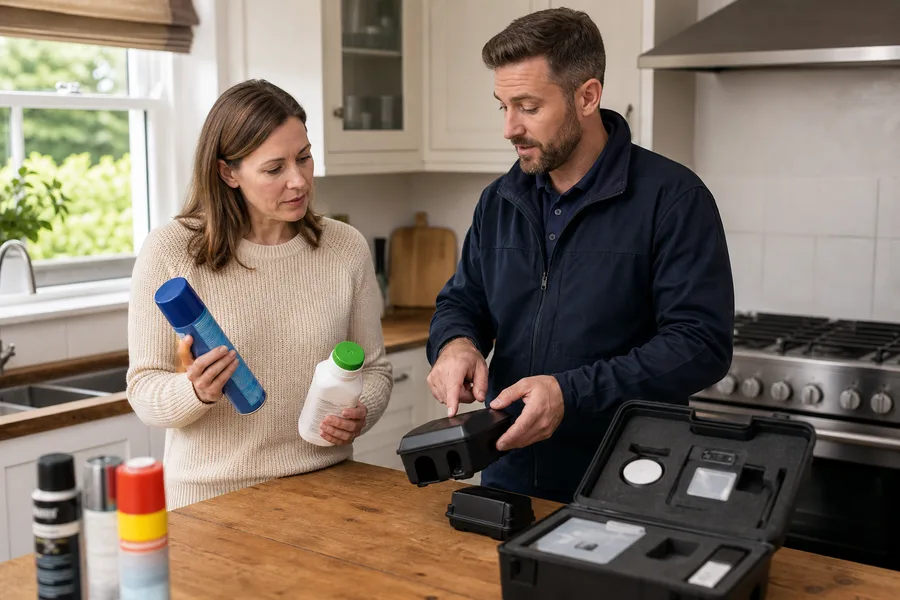
This decision is usually DIY versus professional treatment: professional help is stronger where identification is uncertain, activity is established, pesticides present risk or building proofing is required.
A repair total should include diagnosis, labour, parts, return visits, testing and tax. A replacement total should include removal, installation, adaptations, disposal, certification, commissioning and foreseeable follow-on work. Compare a suitable replacement, not an unrealistically cheap headline product.
Age is a proxy, not a verdict. Consider service history, condition of connected components, availability of support and whether recent failures are related. One expensive repair can still be rational if it restores a sound system; several unrelated failures may indicate that more spending will not buy dependable life.
Safety can override a cost comparison, but ask for the evidence and applicable standard. Efficiency savings should be estimated realistically against the extra capital cost. Check that a replacement is compatible with existing services, controls, software, fittings or surrounding work and that promised benefits apply to your actual use.
Get an independent view where the diagnosis is uncertain, replacement is unexpectedly urgent, the cost is substantial or dismantling has removed your ability to compare options. Provide the second professional with records and photographs without coaching them toward the first conclusion.
Ask how long each option is reasonably expected to last, what remains unchanged, which new warranties apply and what follow-on costs are likely. Ask whether the repair part is new, equivalent or refurbished and whether a replacement requires alterations elsewhere. If predicted savings are part of the case, request the assumptions rather than accepting a headline percentage.
Create two columns for repair and replacement. Record today’s complete cost, expected useful life, warranty, disruption, running cost, unresolved risks and the consequence of failure. Mark which figures are quotes and which are estimates. This does not turn uncertainty into certainty, but it prevents one dramatic number or sales claim from dominating the choice.
Ask how long each route takes, what will be unavailable during the work and whether a temporary measure is safe. Waiting can preserve cash and time to compare, but it can also increase damage or leave an essential service unreliable. Request a clear distinction between “must be made safe now”, “should be addressed soon” and “could be improved later”. That distinction is more useful than a single urgent sales message.
Money already spent on diagnosis or a failed attempt is relevant to your records but does not make the next proposal good value. Pause, calculate the additional cost from today and compare the likely outcome of each option.
No universal percentage works across services. Safety, remaining life, reliability, parts, running cost, disruption and warranty can outweigh a simple repair-to-replacement ratio.
For expensive, uncertain or unexpected replacement recommendations, an independent second opinion is usually sensible.
Not necessarily. Ask for realistic savings for your usage and include installation, adaptation, servicing and finance costs.
Keep diagnostic findings, photographs, test results, quotes, part details, invoices and warranties. They help with a second opinion and any later dispute.
Ask a suitable pest control company to explain repair, replacement and uncertainty in writing.
Compare local providers